|
CSA Legislative Accomplishments and History
2014
Here is a brief update regarding several legislative issues that are likely to arise in the next session in 2015.
DCS and UCONN Retainage: Currently, the maximum retainage that can be withheld on State projects administered through DCS and UCONN is 10% (per Conn. Gen. Stat. section 49-41b). For several years, through administrative policy, DCS had been withholding 7% and then reducing retainage to 3.5%, or lower, as projects neared completion. Recently, however, DCS has withheld 10% retainage on several design build projects (ongoing CCSU dormitory project). The agency, through its legal counsel, reports that the practice of with lower levels of retainage will continue on non-design build projects. CSA will probably seek legislative action soon to implement 5% retainage for all state projects, including DCS and UCONN. (By statute, CDOT is at 2 ½% and municipal and private construction projects are at 5%.)
DCS Bid Listing Changes: In the last legislative session, per Special Public Act 14-18, the Legislature directed the Commissioner of DAS to establish a working group known as the “Construction Contracting and Bidding Transparency Group.” The purpose of the group is to study state construction contracting and subcontracting processes, and issue a report to the Legislature by January 2015. This study committee was established primarily in response to legislative proposals that sought changes to the bid listing requirements for DCS projects. Currently, under Conn. Gen. Stat. section 4b-93, all general bids for State construction contracts exceeding twenty-five thousand dollars are required to list the subcontractors (and their prices) who will be performing the Masonry, Electrical, Mechanical, and HVAC work, and also to use a standard, simple and “clean” subcontract form (per Conn. Gen. Stat. section 4b-96). Proposals submitted in the last legislative session sought to expand the requisite bid listing categories to as many as twenty or more subcontractor categories. A number of individuals representing contractor and subcontractor interests sit on this committee, and are seeking a modest and reasonable expansion of the bid listing categories, as well as broadening the requirements to use a clean subcontract form on all state projects. The study committee’s final report is sure to provide the basis for legislative proposals on this subject next year.
Statute of Limitations on State Projects: By now, everyone is aware that in the case of State of Connecticut v. Lombardo Brothers Mason Contractors, Inc., et al, 307 Conn. 412 ( 012), the Connecticut Supreme Court held that there was no statute of limitations that precluded the State from bringing an action against contractors, subcontractors, or design professionals, or their sureties and insurance carriers, at any time after the completion of a state project. (In the Lombardo case, the State sued all contractors, subcontractors, design professionals, and their sureties and insurance carriers regarding problems with the UCONN Law School project some twelve years after its final completion.) The Supreme Court’s decision was based on the doctrine of sovereign immunity (one cannot sue the State without its permission), as well as the legal theory of nullum tempus – that there is no time limit by which the king can bring a legal action against its subjects.
Predictably, the construction and design professional community have been seeking to change this result through legislation that imposes reasonable statute of limitations on the State for bringing such actions (i.e., ten-twelve years). Such a proposal failed in the last session, but is expected to be aggressively pursued again in the upcoming legislative session.
Steven B. Kaplan, Esq.
Michelson, Kane, Royster & Barger, P.C.
10 Columbus Boulevard
Hartford, CT 06106
Tel: 860-522-1243
Fax: 860-548-0194
E-mail: skaplan@mkrb.com
History
CSA Retainage Legislation Becomes Law
Senate Bill 131 is now Public Act No. 10-148. The law reduces retainage amounts in commercial construction and large residential contracts from 7.5% to 5%.
The law helps subcontractors pay their laborers and material suppliers in a more timely manner. The new law went into effect on October 1, 2010. Read More
CSA achieved a legislative victory with the passage of Public Act No. 09-146, pertaining to change orders. The law became effective on July 1, 2009. Now, payment requisitions and change orders on both public projects for which a payment bond is required, and on private commercial projects requires that a “statement” be applied to all requisitions submitted by both general contractors and subcontractors. The statement must show the status of all pending construction change orders, other pending change directives and approved changes to the original contract or subcontract.
Click Here to View Public Act No. 09-146
In 2008 the General Assembly’s General Law Committee approved a measure that would allow subcontractors to pass through claims to the public owner, thereby allowing subcontractors a means of bringing legitimate claims before the owner without having to obligate their general contractor for this liability.
The “pass-through claims” proposal was sent to the Transportation Committee where no action was taken on the measure. This is the second consecutive year that this measure has won approval from the General Law Committee, but died in another committee. Those opposed to the bill argue that the state will have to pay out millions in claims. The industry argues that if these are legitimate claims, then the awarding authority should be held liable.
During the 2008 legislative session, CSA encouraged members to contact the Transportation Committee to ask that they support the legislation.
In 2007 CSA established its 2007 legislative priorities at a meeting attended by Connecticut Representative Thomas Colapietro (D) Bristol. Priorities include:
- Reduction of public and private retainage requirements to a maximum of 2.5%;
- Payment of full retention with substantial completion of work;
- Increasing time frame for subcontractor to file valid lien from 90 to 120 days;
- Elimination of state provision allowing substitution of securities for retainage;
- Notification from public awarding authorities when payments are made to general contractors/construction managers with detail indicating which subcontractor payments make up the general contractor’s periodic payment.
In 2006, CSA partnered with the Connecticut Bar Association to support a proposal to allow for pass-through claims for subcontractors on public construction.
CSA joined forces with the Construction Law Section of the Connecticut Bar Association to attempt to eliminate the barring of pass through claims by subcontractors. While this bill did not win passage, CSA continues to work for passage. Connecticut is the only state in the country that does not allow pass-through claims for subcontractors.
In 2005 CSA supported a proposal to require subcontractor pre-qualification on major state and pubic construction contracts. In an effort to secure the same type of stringent bidder requirements that now exists for general contractors, CSA supported the establishment of similar requirements for over 21 subcontract trades when their portion of the project exceeds $500,000. The law passed and went into effect in 2007.
DAS Frequently Asked Facts
|
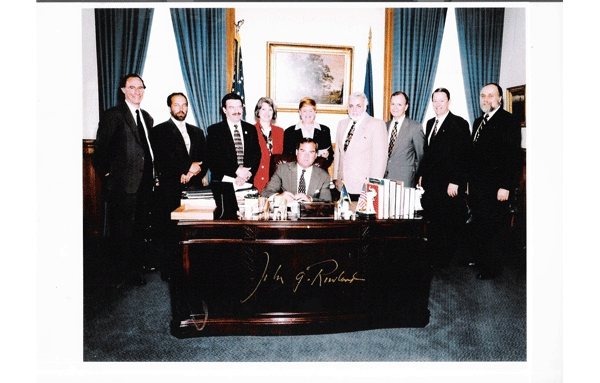
From left to right: :Dan Duffy, Legislative Research; Steve Colapietro, CT Subcontractors Association; Senator Tom Colapietro; Mary Ellen Dombrowski, Independent Electrical Contractors Association; Joyce Wojtas, Connecticut Construction Industries Association; Leo Christmas, Electrical Contractors, Inc.; Chet Bukowski, Michelson, Kane & Royster; Terry Wooding, Petra Corp.; and Dean Logee, CRS New England Pipe |
With the help of Senator Thomas Colapietro (D-Bristol), the Small Business Protection Bill was passed in 2004.
This legislation requires stricter payment guidelines to help subcontractors collect the money they are owed from construction managers, general contractors, or owners. It also requires owners to pay for labor and materials within thirty days of receiving a written request for payment, general contractors to pay their subcontractors for labor and materials within thirty days of receiving payment, and subcontractors to insist on these provisions in their contracts with other subcontractors and suppliers.
The Connecticut General Assembly also passed a CSA proposal mandating payment and performance bonds for construction managers when working on municipal construction projects.
Prior to the passage of this measure, Connecticut municipalities were not required to mandate a bond for construction managers. Construction managers were, therefore, not bonded, which offered no protection to the subcontractors on the project should the construction manager default. With the passage of this legislation the municipality became the financially responsible party should they fail to require the construction manager on a project secure a payment and performance bond from a surety.
In addition CSA supported a bidder pre-qualification initiative to establish a statutory requirements for bidders bidding on major state and other public construction projects.
CSA also worked with the general contractors in support of a legislative initiative to establish quantifiable bidder qualifications for general bidders bidding on state and public construction projects.
A CSA proposal to establish retainage escrow accounts on private construction contracts passed the Connecticut General Assembly in 2003. This was a major legislative achievement, as the new legislation requires that, if requested, private owners and general contractors must establish a non-interest bearing escrow account. Failure to do so would allow a subcontractor to secure court costs and attorney’s fees if successful in litigation.
In 2003 CSA also joined forces with the Associated General Contractors (AGC) to support issues of mutual concern. CSA and AGC began to work together as equal partners in a collaborative effort to make meaningful changes to correct long-standing issues of inequity for subcontractors and general contractors in the public and private markets.
CSA secured passage of legislation to ameliorate the effects of risk transfer to subcontractors in 2002. With this first legislative victory, CSA effectively spread the risk among all parties associated with a given claim.
In 2001, the Connecticut Subcontractors Association (CSA) was incorporated and the association took immediate action to establish itself as the voice of the Connecticut subcontractor. CSA hosted a meeting at which the Business Practices Interchange was established. This provided subcontractors with a voice to share their issues and concerns with regard to the industry practices of contractors for whom they are working or have worked in the past.
CSA also establishes an on-going relationship with the State Department of Public Works that resulted in an annual “State of the State” program hosted by the Commissioner of Public Works.
In addition CSA establishes itself as the voice of the “lone subcontractor” by standing up to public, private and quasi organizations to insure compliance with state retainage practices. The association succeeded in having retainage reduced on projects in compliance with the state statute.
|